

“You never know when you’ll need it:” How stroke care at WRHN changed a donor’s perspective
Patient Story
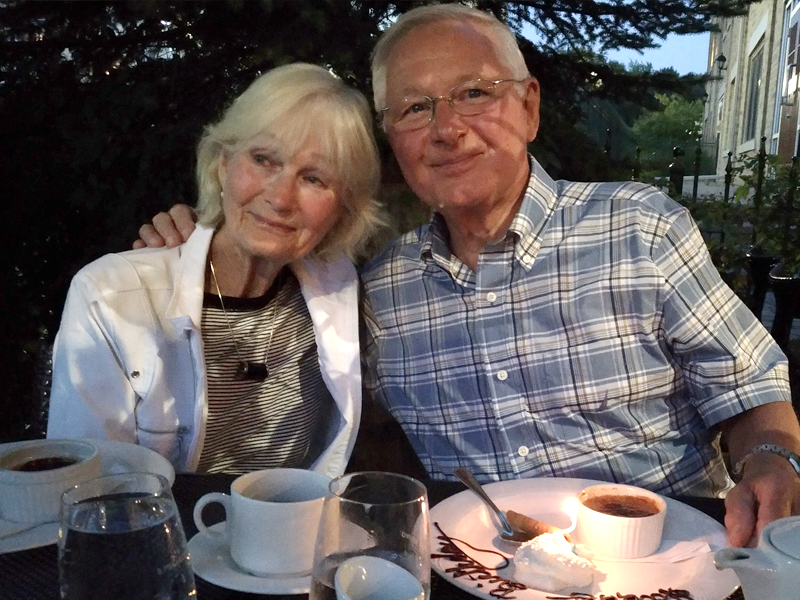
It was a typical spring morning for Tom Hendrick: he woke up at his usual time, went downstairs, and started making breakfast for his wife Jane, as he often did.
But somewhere between brewing coffee and cracking eggs, the mood of the morning changed from peaceful to panicked.
Jane was the first to notice.
“I came down and asked: ‘what’s for breakfast,’ and Tom turned to me and started slurring his words,” Jane says.
Right away when that happens, you know something’s wrong. And you just jump into action.
Knowing slurred speech is a sign of stroke, Jane called 9-1-1. When paramedics arrived at their West Montrose home, they ran tests and told Jane they were taking Tom to Waterloo Regional Health Network (WRHN).
At first, Jane was perplexed. The hospital in Fergus was much closer than WRHN @ Midtown in Kitchener. She asked paramedics why they needed to travel further.
“They looked at me and said: ‘If this is a stroke, you want to be at WRHN,’” Jane recalls. “And I think that’s when the severity of the situation really hit me.”
The power of specialized care
The stroke program at WRHN – accredited for leading excellence in stroke care – serves an area of approximately 1 million people across Waterloo-Wellington.
It offers a full continuum of care including emergency services, a stroke unit, a rehabilitation program, and a stroke prevention clinic.
Through Tom’s patient journey, he touched almost all of those areas.
When Tom first arrived at the emergency department, he underwent several diagnostic imaging tests, including an MRI scan that confirmed the stroke.
As a former business owner – Tom owned Elmira Stove Works for nearly 50 years – he was amazed by how well his care team worked together.
“Everything was very efficient,” Tom says. “Before every test, they let us know what was about to happen, they got me in quickly and they made sure I had the scans I needed."
Once we had the MRI, it really felt like a relief: Now we knew what we were dealing with and the doctors could help me get better.
Tom spent a week in the stroke unit at WRHN @ Midtown, healing and progressing from the stroke that had impacted his speech and movement on the left side of his body.
After that, he was transferred to the rehab program at WRHN @ Chicopee, where he spent the next three weeks.
Reclaiming strength and community
Twice a day, he’d do leg exercises with a physiotherapist named Sarah to strengthen his weakened left side. Then, he’d have math and language sessions and memory work with Shannon, a cognitive specialist.
“They’d come in and say: ‘come on, Tom, you can do this!’ And they would be so cheery,” he says. “They took remarkable care of me.”
WRHN @ Chicopee is also where Tom and Jane met a community of fellow recent stroke patients. Having others around who understood their struggles was an unexpected blessing for Jane.
“We made connections, we had picnics together outside,” Jane says. “It was quite lovely to have that sense of community."
We were like one big family.
The rehab process wasn’t always easy for Tom.
After a long career as a business leader, he was used to being in charge. Having to suddenly rely on others for basic needs was frustrating at times.
"I work for 60 years, and then three years into retirement, I have a stroke and need help for everything – so that was an adjustment,” Tom says with a smile. “But day by day, I got stronger and then one day, I was able to do things by myself again."
Regaining that independence meant so much. And I can’t thank WRHN enough for giving me my life back.
Generosity that comes full circle
Tom and Jane have been regular donors to WRHN Foundation for years, starting long before they ever needed care there.
After selling Elmira Stove Works, the couple made a large donation to a campaign that upgraded an existing MRI at WRHN @ Midtown and brought a new one to WRHN @ Queen’s Blvd.
Three years later, when Tom unexpectedly found himself needing one of those MRIs to diagnose his stroke quickly and accurately, it brought up a slew of emotions.
“Tom’s experience really highlighted the importance of donating,” Jane says. “We’ve seen the impact first-hand, and we know exactly how this money will help people."
“Moments like these make you realize you have to give back to your community,” Tom adds.
You never know when you’ll need it.

Be part of a generational opportunity to strengthen our health network.
Support new ways to connect the 1.4 million people across WRHN’s catchment area to the care they deserve.

Let your experience inspire others.
Whether you’re a patient, family member, donor, event participant or proud WRHN staff, sharing your story and connection to Waterloo Regional Health Network (WRHN) is a powerful way to show how donations impact our community in real, tangible ways.